
Voice Is a Mode, Not a Bot
Adding speech and a live avatar to a grounded chat without changing the retrieval stack
A speech-to-text & text-to-speech roundtrip on my personal RAG chat: Grok-first audio with Cloudflare Workers AI and self-hosted fallbacks.
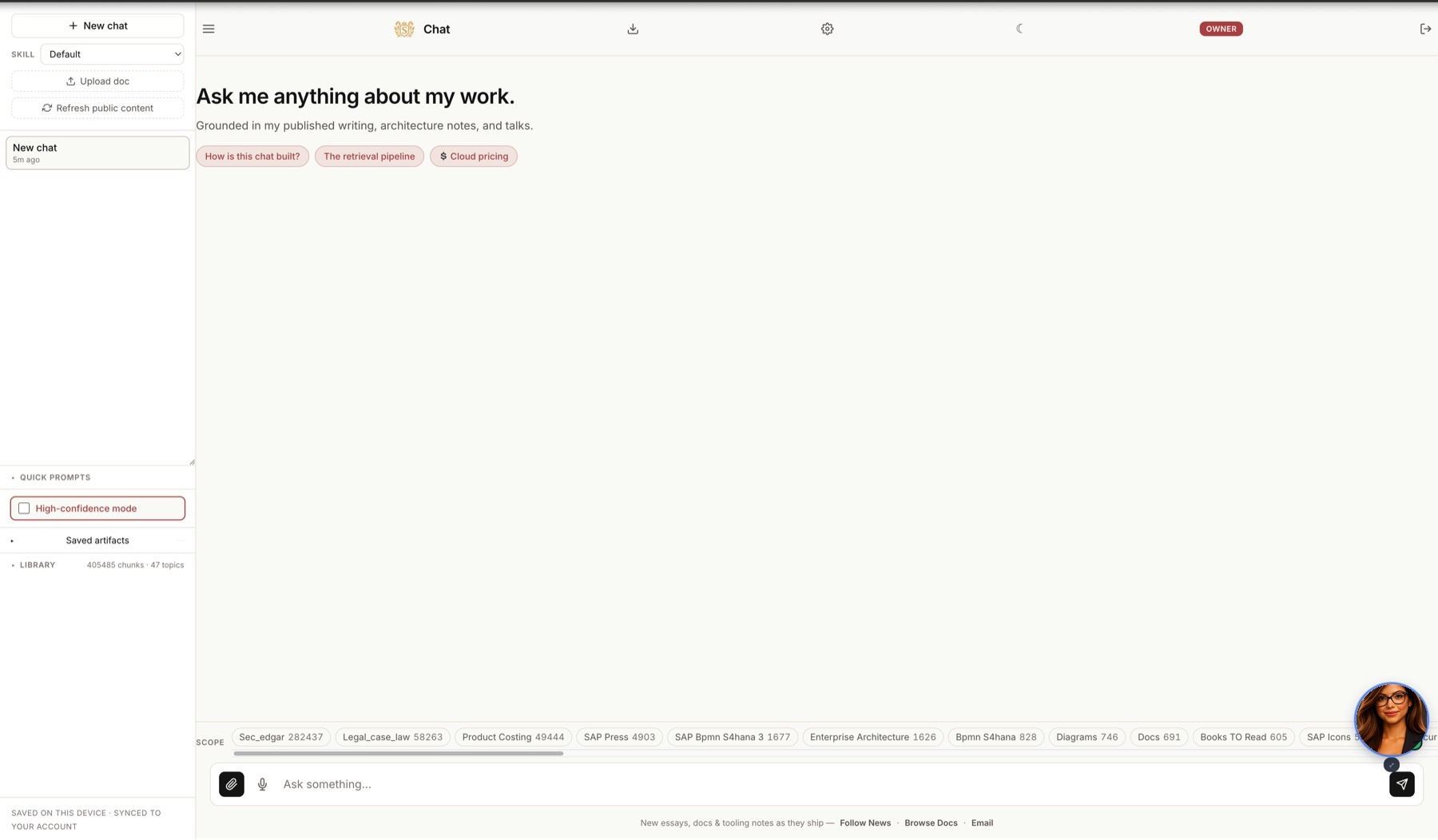
My personal chat at chat.sajivfrancis.com can now talk to me.
Tap the avatar in the corner, ask a question out loud, and the full answer appears on screen with code, diagrams, and citations included, while the avatar speaks a shorter, conversational version.
Updated 2026-08-22: the audio pipeline has since moved to Grok as its primary provider, the turn-based loop became a real conversation, and the static portrait became a live 2.5D figure; this post now describes the current architecture.
It started as a simple experiment: I asked an image model to illustrate a persona for my site, and Maya was the result.

She is now the site’s single mascot: the landing page, the docked voice avatar, and the animated full-body view all derive from this one image, so she looks the same wherever you meet her. (A male counterpart waits in the repo for a future avatar picker.)
The architecture
The key decision was to make voice a mode of the existing chat, not a separate bot.
A spoken question follows exactly the same pipeline as a typed one: transcription → existing RAG/retrieval + chat history → full answer. Nothing in the existing RAG stack needed to change.
The full response is rendered normally on screen. A small model then turns it into 2 to 4 sentences of conversational prose, which goes through TTS.
That also solves a surprisingly important problem: the voice never reads code at you.
Rather than trying to strip Markdown, diagrams, and code from the original answer, I generate a separate response specifically designed to be spoken.
Browser-side Silero VAD detects when I’ve stopped talking, so there’s no push-to-talk. Speaking over the avatar interrupts playback, a real barge-in that cancels generation server-side rather than just muting the audio.
Every audio primitive sits behind a provider chain rather than a single vendor. Grok is the primary for both directions: its STT returns word timings and accepts key-term biasing for my personal vocabulary, and its TTS (Maya speaks in the ara voice) streams with low first-byte latency. Workers AI (Whisper, Deepgram Aura) serves as the on-stack fallback, and self-hosted faster-whisper on my droplet is the always-available last resort. No key, no problem: without the Grok key the chain simply behaves like the original Workers AI build.
flowchart TD
    A[Mic + browser VAD<br>detects end of utterance] -->|"WAV, owner-token gated"| B["/api/voice/stt<br>Grok STT, word timings +<br>personal-vocabulary biasing"]
    B -->|transcript| C[Existing RAG chat pipeline<br>retrieval + history, unchanged]
    C -->|"bridge line, instantly"| K["Conversational buffer:<br>context-aware spoken ack<br>while the answer generates"]
    C -->|full answer| D[Screen: markdown,<br>code, diagrams]
    C -->|full answer| E["/api/voice/summary<br>small model distills<br>speakable sentences"]
    E -->|"sentence-chunked prose"| F["/api/voice/tts<br>Grok TTS (ara voice)"]
    F -->|"gapless audio chunks"| G[Live 2.5D avatar speaks:<br>lip sync, blinks, breathing.<br>Talk over her to interrupt]
    B -.->|fallback| H[Workers AI Whisper,<br>then droplet faster-whisper]
    F -.->|fallback| I[Deepgram Aura<br>on Workers AI]
Two things in that diagram didn’t exist in the first version of this post. The conversational buffer speaks a fresh, topic-aware bridge line the moment your question is understood (“Pulling up the order-to-cash flow, one sec”) instead of dead air, then hands off to the real answer as sentence-chunked, gapless TTS. And the avatar herself is no longer a static portrait: a small WebGL engine renders her from a two-layer depth package, so she breathes, blinks, shifts her weight, and lip-syncs to the audio level while speaking.
The pricing lesson
Everything initially ran on Cloudflare Workers AI: Whisper for transcription and Deepgram Aura for TTS. I thought the free allocation would comfortably cover personal testing. It did not.
I had misread the billing units by three orders of magnitude:
| What I assumed | What it actually was | |
|---|---|---|
| TTS billing rate | ~2.7 neurons per 1,000 characters | ~2.7 neurons per character |
| Free daily allocation | 10,000 neurons | 10,000 neurons |
| TTS characters/day | ~3,600,000 | ~3,700 (≈ a dozen spoken replies) |
The result, mid-testing: AiError 4006: daily free allocation exhausted.
Fortunately, I already had faster-whisper running on my own droplet, so I added it as a transcription fallback. I also added visible failure states to the avatar, because a voice interface should never silently fail and pretend it didn’t hear you.
That pricing lesson is also what reshaped the architecture above: at roughly $4.20 per million characters, Grok TTS costs about a dollar a month at heavy personal use, so it became the primary provider. I implemented it as a chain rather than a swap, which is why the free-tier fallbacks survive as resilience instead of dead code.
What’s next
The first version of this list said “make it feel like a real conversation”: sentence-chunked TTS, server-side barge-in, a conversational mode. Those shipped, along with the live 2.5D avatar. What’s still ahead:
- Full-duplex streaming: Grok’s WebSocket STT with
smart_turnend-of-turn detection, replacing batch VAD → transcribe entirely. - Word-timestamp lip-sync: Grok TTS already returns word timings; the engine currently syncs to audio level.
- A true 3D Maya: the current avatar is a 2.5D depth mesh built from one image. The end state is a background-free 3D figure speaking over the page itself, the website as her backdrop rather than a painted one.
The bigger lesson for me is that a personal site is a great place to run these experiments.
It’s low stakes. I can try new models, discover pricing mistakes, swap providers, measure latency, and learn what actually works, then carry the useful architecture into projects where it matters.
Updated August 22, 2026.